
The Plumeria Pests and Diseases Guide is an essential resource for identifying, preventing, and treating the most common threats to plumeria plants, including pests, fungi, and environmental stressors. This guide offers detailed information on how to recognize early signs of trouble, from insect infestations to fungal infections, and provides practical solutions to address these issues. It also covers strategies for managing environmental factors such as excessive humidity, temperature fluctuations, and poor soil conditions, which can weaken plumeria. With expert tips on natural and chemical treatments, as well as proactive care practices, this guide ensures your plumeria remains healthy, resilient, and free from common ailments, allowing it to thrive season after season.
Plumeria Pest & Disease Identification Guide
What to check next
This guide helps you separate infectious disease from pests, exposure injury, nutrition symptoms, and normal aging before pruning or treating. Read the detailed explanation, then use this sequence to decide what to do.
Confirm the evidence for a possible pest or disease
- Look for
- Active insects, eggs, webbing, honeydew, frass, slime, spores, expanding lesions, odor, soft tissue, or another repeatable defining sign.
- Compare with
- Water stress, root problems, nutrition, sun, cold, spray injury, and normal aging can resemble pest or disease damage without an active cause.
- Safest first response
- Isolate when practical, photograph both sides and the whole plant, inspect with magnification, note whether damage is advancing, and treat only after the closest match is supported.
Microclimate clue: Temperature, humidity, leaf wetness, root-zone moisture, airflow, recent weather, and plant crowding can shift both pest activity and disease pressure.
- 1
Stabilize and isolate
Keep questionable plants away from healthy collections and avoid splashing water or sharing tools.
- 2
Describe the tissue
Note whether damage is dry, powdery, water-soaked, sunken, soft, foul-smelling, or one-sided.
- 3
Map the progression
Photograph and mark the edge so you can tell whether the condition is spreading.
- 4
Confirm the closest match
Compare the defining sign, not only leaf color, and use laboratory testing when needed.
- 5
Intervene narrowly
Remove only unsalvageable tissue, sanitize tools, and treat only when the diagnosis supports it.
How microclimate changes this answer
Long leaf wetness, warm humidity, poor airflow, and cool wet roots increase disease pressure; intense sun and cold create look-alikes.
This guide is the starting point for identifying common plumeria pests, diseases, and look-alike stress problems. Use it when you can see a symptom but are not sure what is causing it. The goal is to narrow the problem first, then move into the correct detailed article for treatment, prevention, or recovery.
Why this matters: plumeria problems often look similar at first. Sticky leaves may point to aphids, mealybugs, scale, or whiteflies. Spots may come from rust, leaf spot, sunburn, nutrient stress, or water stress. Soft tissue may be rot, cold injury, bacterial collapse, or an overwatered root zone. Correct identification helps you avoid unnecessary sprays, missed root problems, and treatments that make the plant weaker.
Choose How You Want to Start
Select the path that best matches what you know now. You can return here if the first path does not fit.
Use a Photo
Upload a current photo or select the closest example. An account is required to upload photos and save review history.
Start a Photo-Assisted ReviewCheck Insects and Pests
Use this for chewing, honeydew, webbing, bumps, cottony clusters, frass, trails, or visible insects.
Open the Insect & Pest CheckerCheck Disease and Rot
Use this for spots, powder, pustules, black tips, soft tissue, odor, stem injury, or sudden collapse.
Open the Disease & Rot CheckerAsk a Question
Describe the problem in your own words. Saved Growing Area, recent weather, and plant-stage details can tailor the answer.
Ask Plumeria Care GuideQuick Symptom Finder
Start with what you can see, then open the closest comparison page before treating. Many plumeria problems overlap, so the first goal is to narrow the pattern.
Sticky Leaves, Ants, or Sooty Mold
Compare sap-sucking pests first: sap-sucking pest checklist, aphids, mealybugs, scale, and whiteflies.
Dusty, Stippled, Bronzed, or Webbed Leaves
Check mites and mite look-alikes: spider mites, rust mites, and the leaf spot vs. rust vs. sunburn comparison.
Orange Powder or Spots Under Leaves
Start with plumeria rust, then compare rust mites, leaf spot, sunburn, and nutrient or water stress if the underside does not show true orange pustules.
White Film, Powder, or Surface Growth
Check powdery mildew, but compare with mineral residue, spray residue, dust, mealybug wax, whiteflies, and mixed leaf disease symptoms.
Chewed Leaves, Holes, Trails, or Night Damage
Compare chewing and surface-feeding pests: May/June beetles, caterpillars, grasshoppers, leaf miners, and snails or slugs.
Entry Holes, Frass, Hollow Stems, or Wilted Tips
Start with plumeria bore worm and borer damage. Internal pests are easy to miss until a branch weakens or collapses.
Weak Growth With Root-Zone Decline
Compare below-soil problems: soil-dwelling pests, root rot, root mealybugs, root aphids, and nematodes.
Soft Stems, Black Tips, Wet Spots, or Collapse
Use the rot and bacterial path: stem rot, black tip rot, bacterial soft rot, and the disease symptom checklist.
Seedlings Pinch, Collapse, or Fail Early
Start with the seedling pest and disease checklist, then compare damping off, seedling rot, fungus gnats, mites, and humidity or media problems.
Mottling, Rings, Color Breaks, or Virus-Like Patterns
Compare Plumeria mosaic virus, Frangipani mosaic virus, nutrient stress, mites, herbicide injury, and other patterned leaf symptoms.
Have a useful photo? See the Plumeria Pest & Disease Photo Contribution Guide for permission wording, credit details, and the highest-priority images needed.
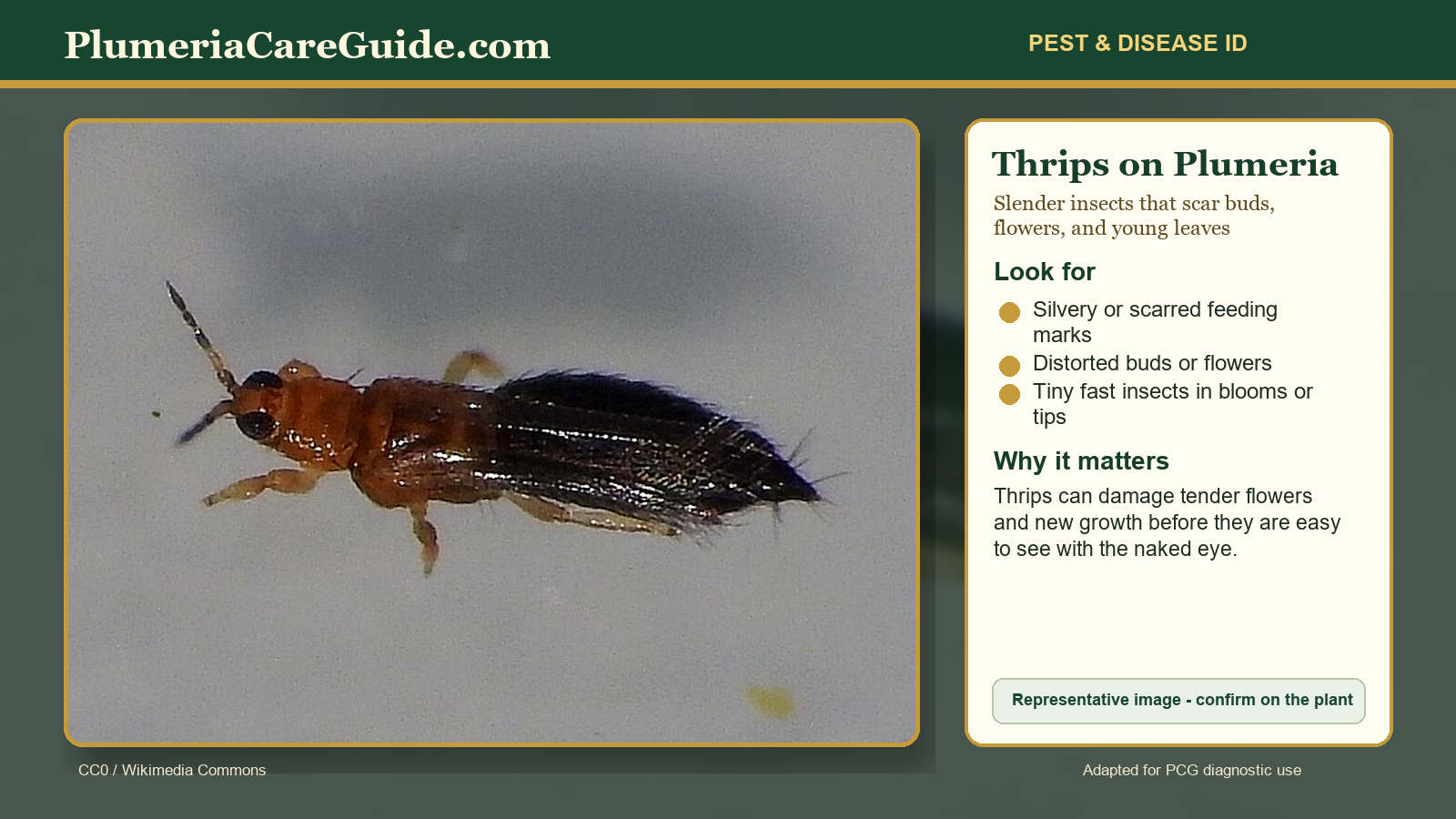
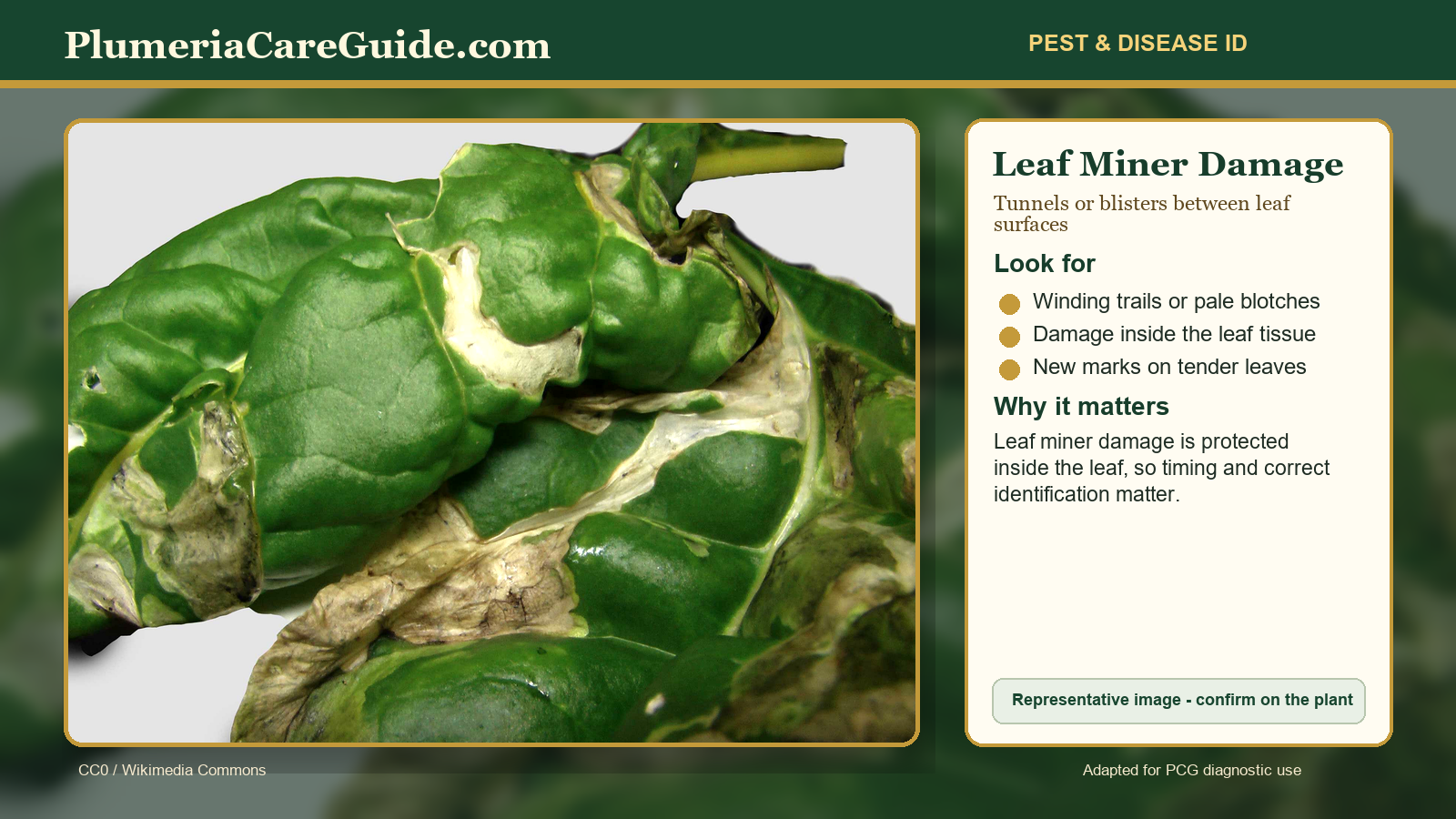
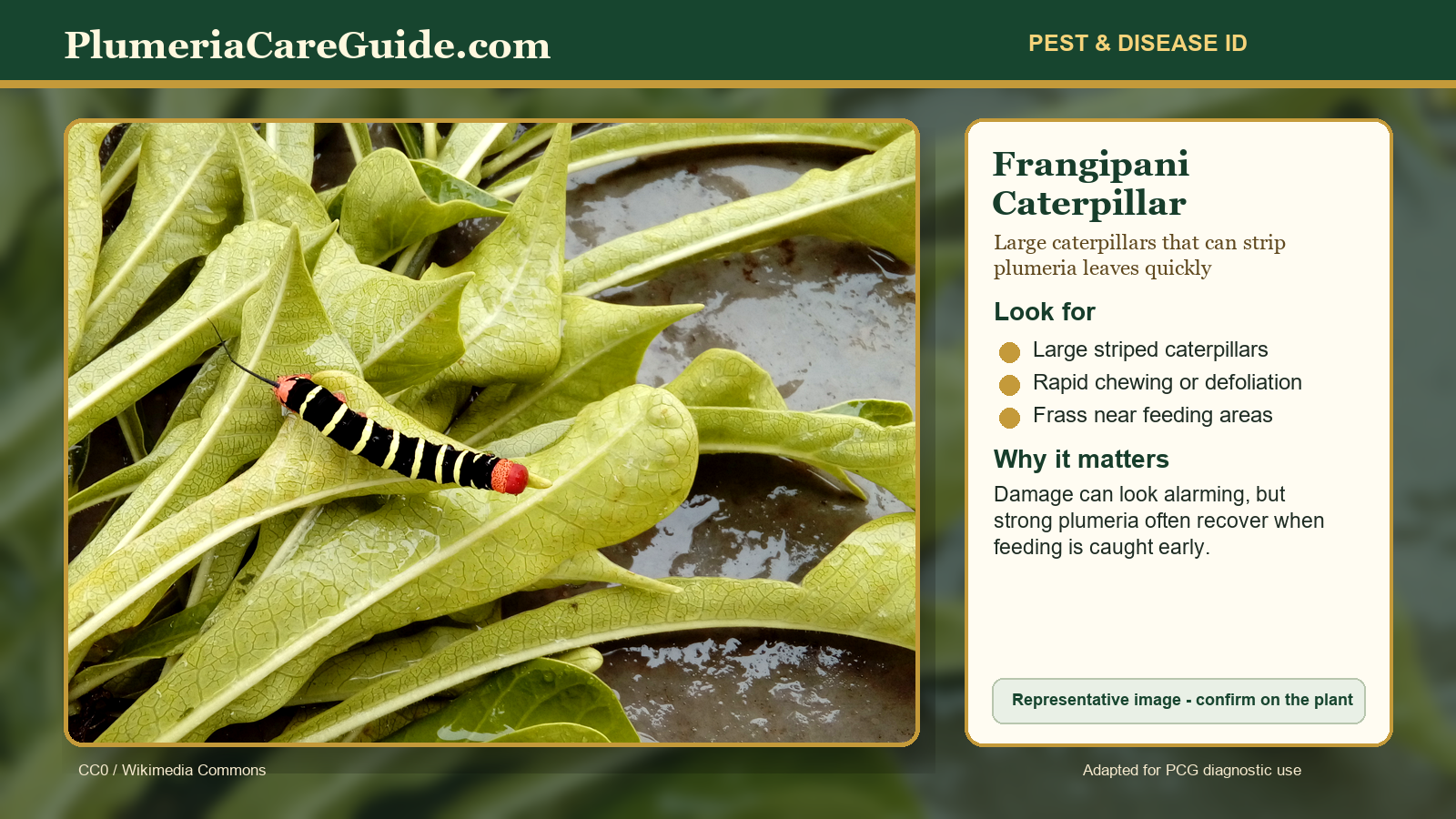
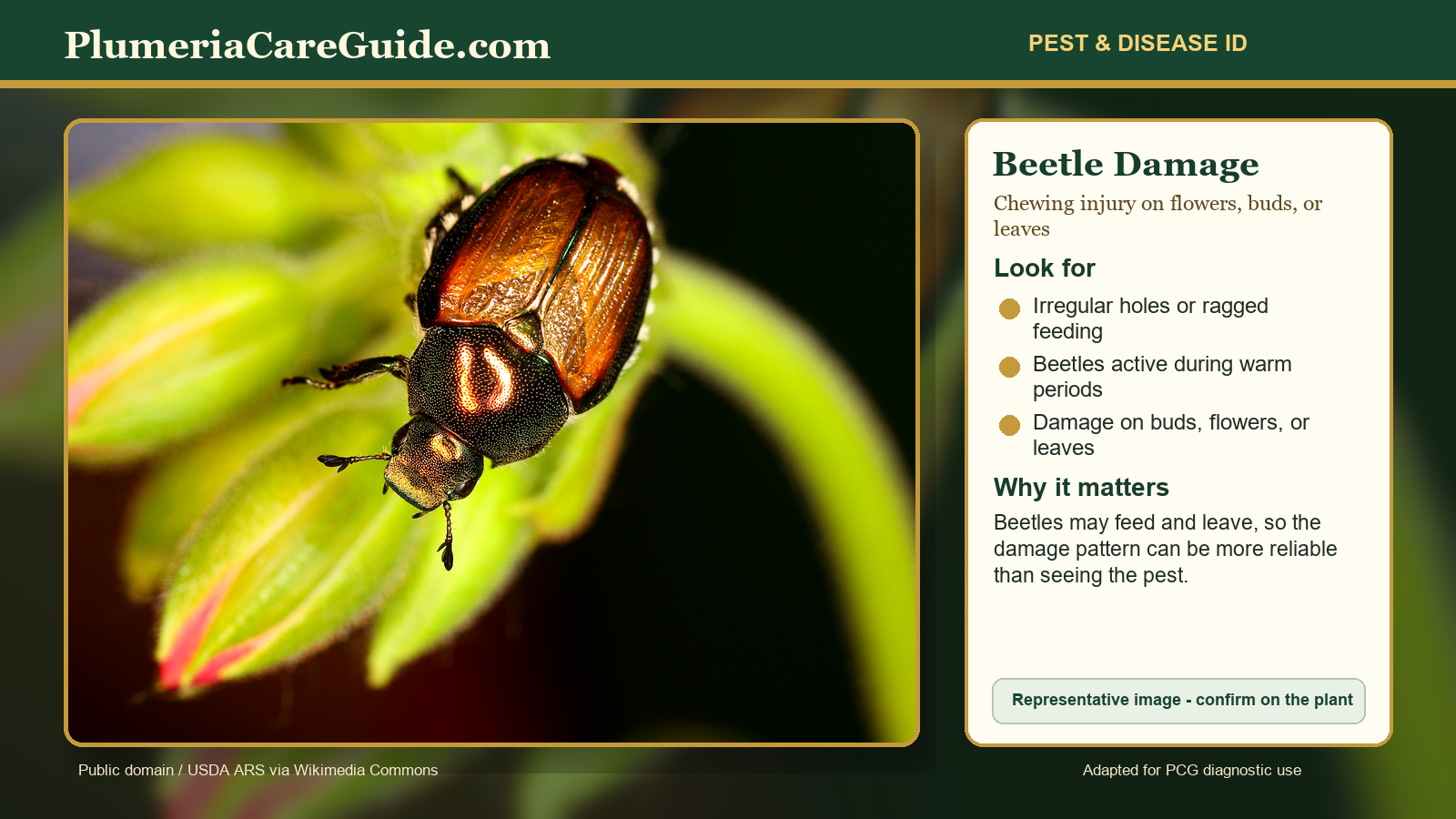
Visual Identification Examples
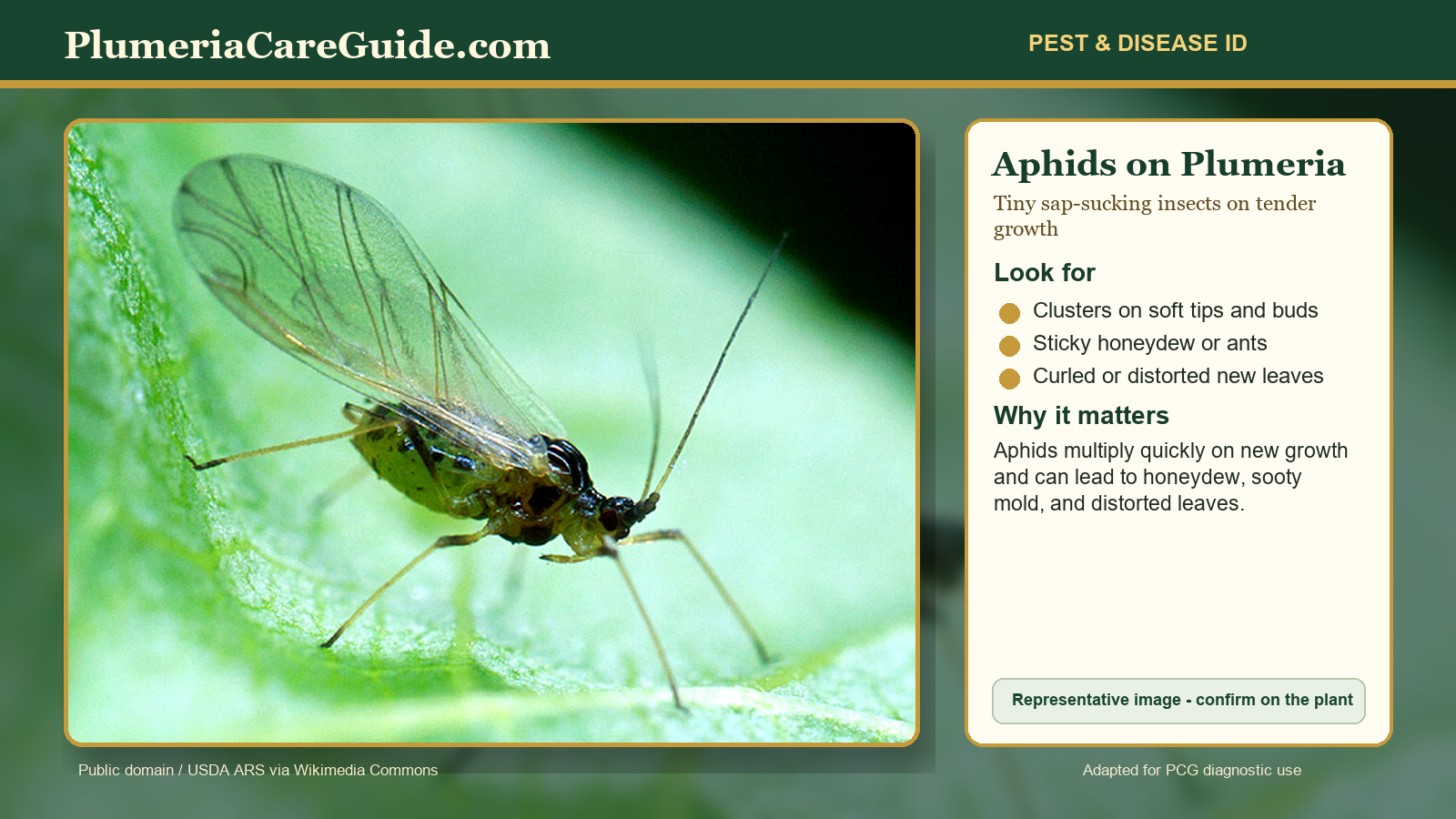
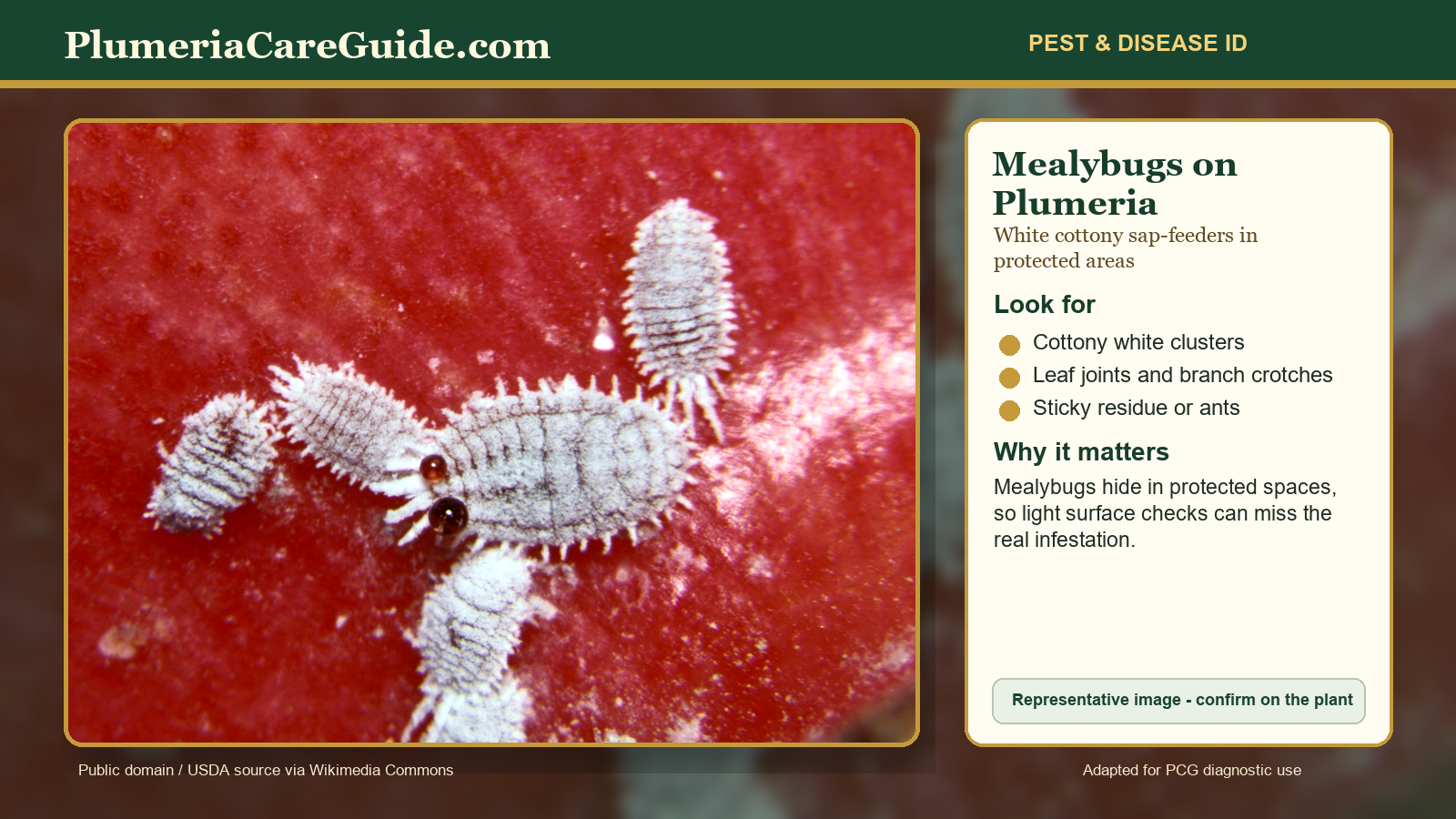
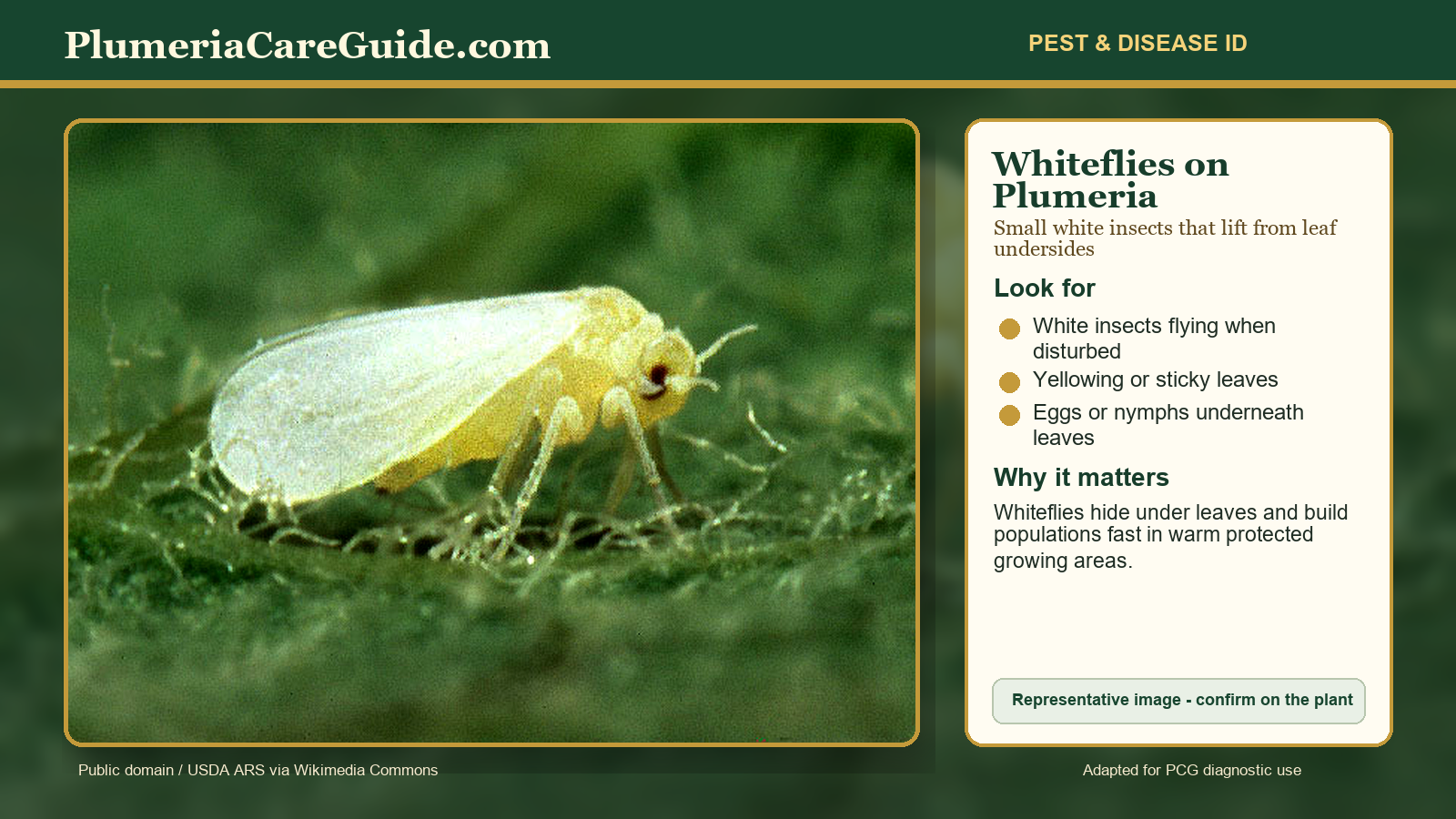
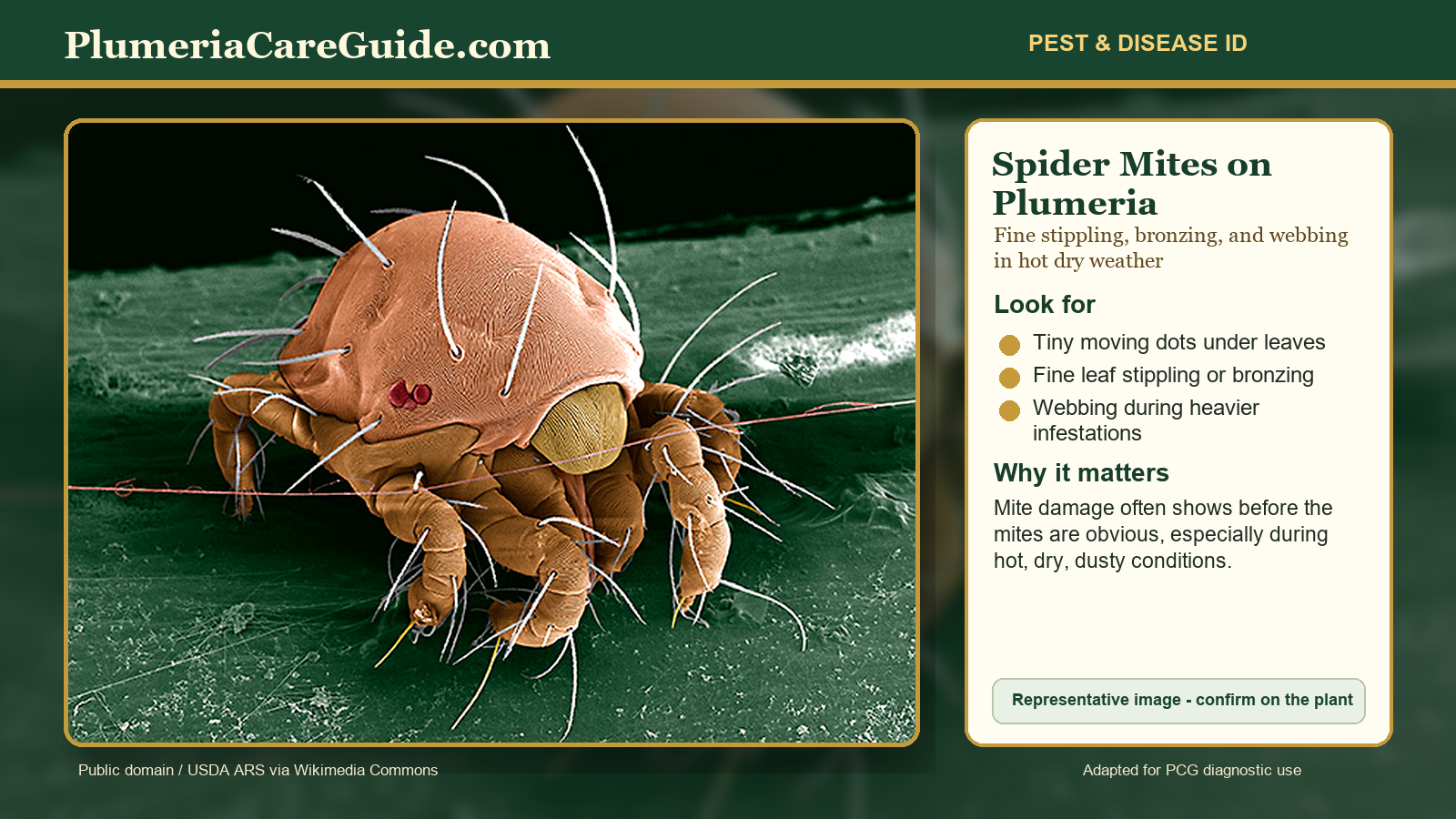
Use these diagnostic images as quick visual references, then confirm the full symptom pattern before treating. Some images are representative examples, while plumeria-specific source images and permissions are noted where needed.
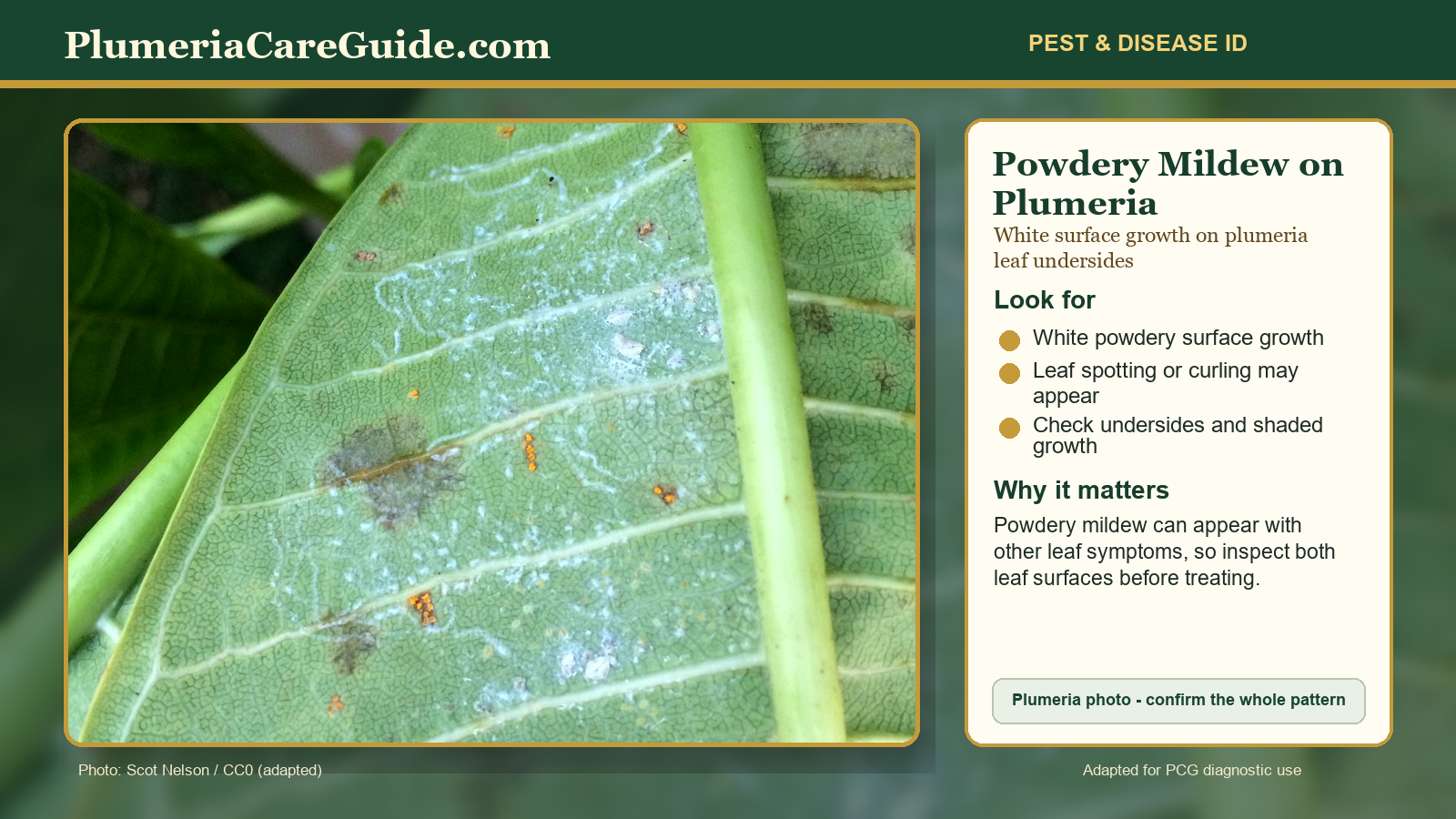
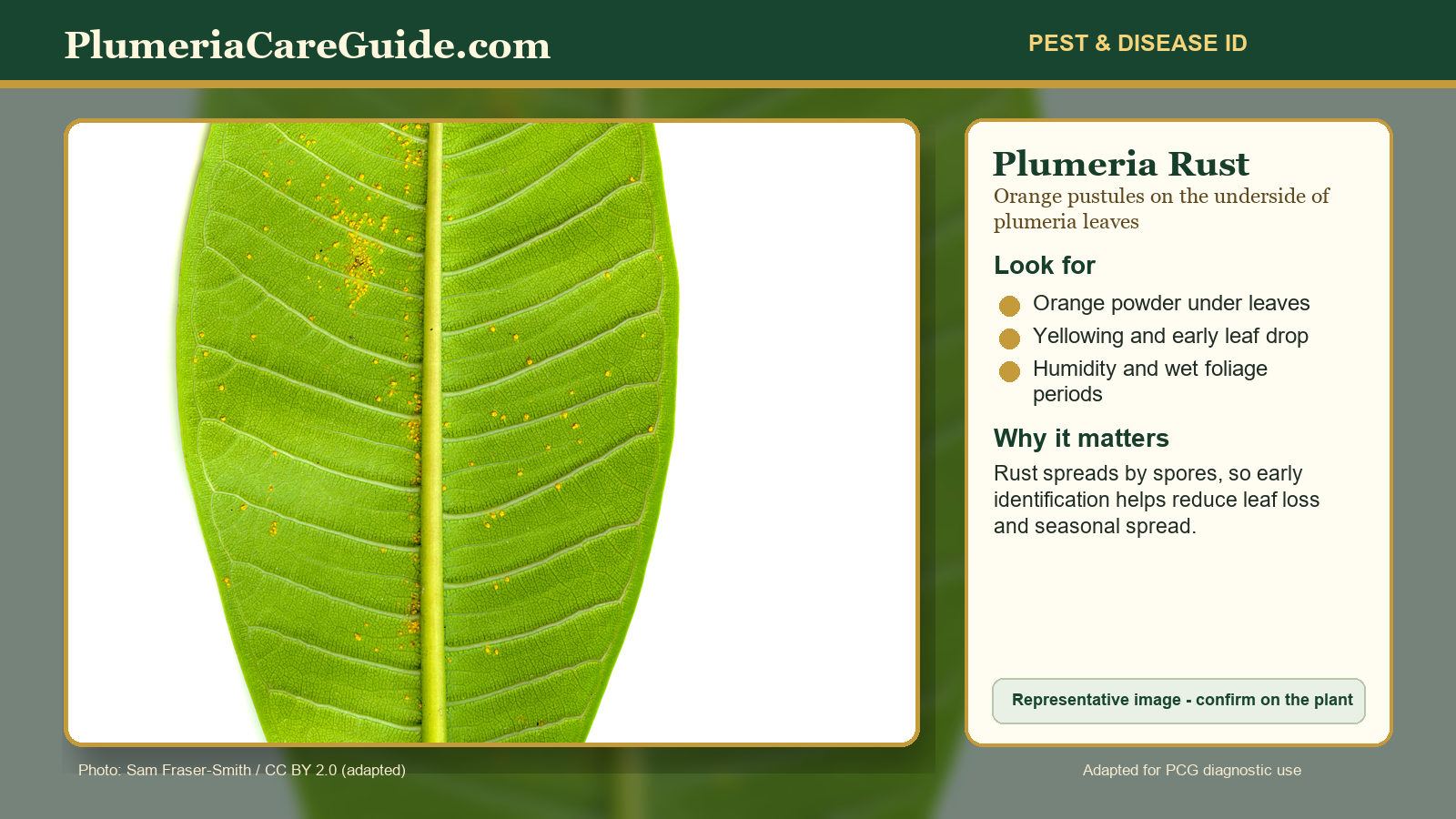
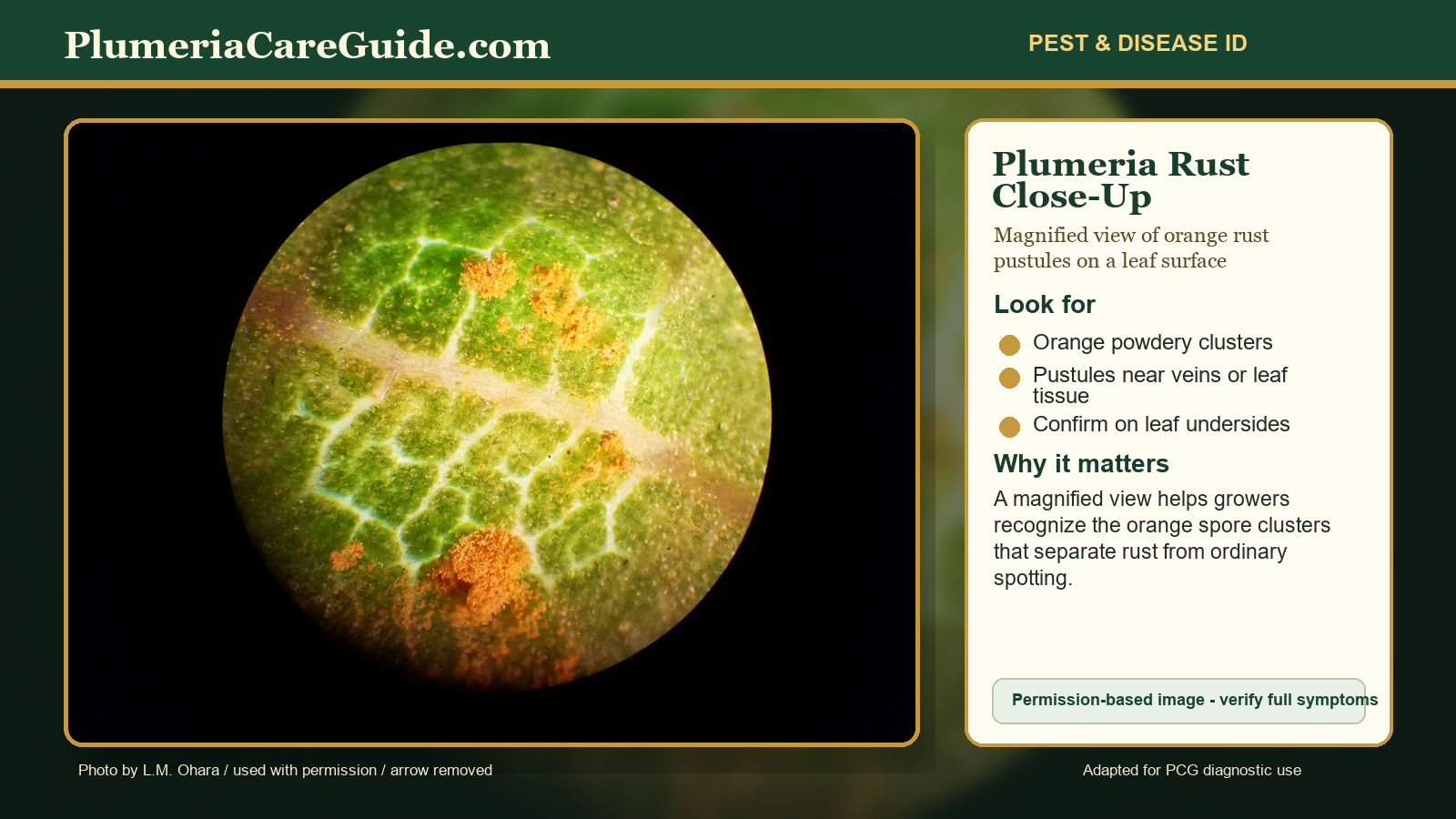
Start With the Pattern
| What You See | Most Likely Direction | Why It Points There | Next Step |
|---|---|---|---|
| Sticky leaves, ants, black surface mold | Sap-sucking pests | Aphids, mealybugs, scale, and whiteflies excrete honeydew that attracts ants and supports sooty mold. | Use the sap-sucking pest checklist |
| Fine stippling, bronzing, dull leaves, webbing | Mites | Mites feed from leaf undersides and often leave fine speckling before the plant looks obviously damaged. | Check for spider mites |
| Orange powder on leaf undersides | Plumeria rust | Rust usually starts underneath leaves as orange pustules and often causes yellowing and leaf drop. | Identify plumeria rust |
| White dusty film on leaves or tips | Powdery mildew | Powdery mildew grows on the surface and is favored by poor airflow, humidity swings, and tender growth. | Identify powdery mildew |
| Soft stems, bad odor, watery decay | Rot or bacterial soft rot | Soft, collapsing tissue usually means moisture, infection, or damaged tissue is advancing faster than the plant can seal it off. | Check for stem rot |
| Wilting despite wet soil | Root rot or root-zone pests | Roots may be unable to move water even when the pot is wet, often from poor drainage, decay, or hidden soil pests. | Check root rot symptoms |
| Holes, missing leaf edges, frass, chewing | Chewing or boring pests | Physical feeding damage usually leaves cut edges, holes, tunnels, pellets, or entry points. | Compare chewing pests |
| Mottling, streaking, unusual color break, distorted growth | Virus or virus-like stress | Viruses and severe stress can create persistent patterns that do not wash off, rub off, or resolve like ordinary leaf spots. | Review mosaic virus symptoms |
Core Inspection Checklist
Before treating, inspect the whole plant. Many plumeria problems start in one place but show symptoms somewhere else. Root problems can look like leaf wilt. Sap-sucking pests can lead to sooty mold. Rot can begin at a wound, leaf scar, cutting base, or cold-damaged tip.
- Look at the newest growth. Tender tips and flower buds attract aphids, thrips, whiteflies, mites, and fungal issues.
- Check leaf undersides. Rust, mites, whiteflies, scale, and eggs are often easiest to find underneath.
- Watch for ants. Ants often reveal honeydew-producing pests before the grower notices the insects.
- Inspect stems and leaf scars. Soft spots, sunken areas, blackened tips, and wet scars can point to rot or canker.
- Check the root zone. Sour smell, soggy media, poor drainage, root decline, and small flying insects point below the soil line.
- Separate look-alikes. Heat, sunburn, fertilizer burn, cold damage, drought stress, and transplant stress can mimic disease.
For a step-by-step inspection routine, start with the Pest and Disease Inspection Checklist.
Sap-Sucking Pests
Sap-sucking pests feed from tender plant tissue or protected leaf surfaces. They often cause distorted new growth, sticky honeydew, ants, yellowing, black sooty mold, or gradual weakening. The reason identification matters is that different pests hide in different places and respond to different treatment timing.
| Problem | Best Clues | Why It Matters | Detailed Guide |
|---|---|---|---|
| Aphids | Soft clusters on new tips, buds, and tender leaves; sticky residue; ants. | They multiply quickly on new growth and can distort leaves before the plant hardens off. | Identify aphids |
| Whiteflies | Small white insects flying when leaves are disturbed; yellowing; honeydew. | Adults scatter easily, so leaf underside inspection is more reliable than waiting to see them fly. | Identify whiteflies |
| Mealybugs | White cottony clusters in leaf joints, branch crotches, roots, or protected folds. | They hide well and can survive in protected spots after light surface treatments. | Identify mealybugs |
| Scale insects | Small raised bumps on stems or leaves; honeydew; slow decline. | Scale can look like part of the bark, so growers may miss it until populations are established. | Identify scale insects |
| Thrips | Scarring, streaking, distorted buds, damaged flowers, silvery feeding marks. | Thrips are small and fast, and flower damage may appear before the insects are easy to see. | Identify thrips |
| Leafhoppers | Small jumping insects, stippled leaves, edge stress, occasional distortion. | Movement gives them away; they can be confused with other small insects unless disturbed. | Identify leafhoppers |
Mites
Mites are not insects, and they often require closer inspection. Their damage is usually seen before the pest itself. On plumeria, the most common mite issue is usually spider mite damage, especially under hot, dry, dusty, crowded, or protected growing conditions. The key diagnostic split is this: spider mites usually cause stippling, bronzing, webbing, and leaf drop, while broad mites and cyclamen mites are more likely to distort tender new growth and buds.
| Mite | Scientific Name or Group | Best Clues on Plumeria | How to Use This Clue |
|---|---|---|---|
| Twospotted spider mite | Tetranychus urticae | Fine yellow or white stippling, dull or dusty leaves, bronzing, webbing, leaf drop, and decline during hot dry stress. | This is one of the most common spider mite problems on ornamentals and should be one of the first mites checked on plumeria. |
| Sixspotted spider mite | Eotetranychus sexmaculatus | Yellow speckling, bronzing, leaf distortion, premature leaf drop, weak new growth, damaged tips, and sometimes webbing under leaves. | This mite is specifically associated with plumeria and is important to know, especially when damage clusters along leaf undersides near veins. |
| Red spider mites | Grower term; species varies | Reddish mites, rusty or bronzed leaves, tiny pale dots, fine webbing, tired-looking foliage, and leaf drop. | Treat this as a descriptive field term, then confirm by symptoms and underside inspection rather than assuming one exact species. |
| Broad mites | Polyphagotarsonemus latus | Twisted or distorted new leaves, hardened or shiny new growth, stunted tips, curled leaves, and damaged buds. | Suspect broad mites when the newest growth is distorted but older leaves do not show classic spider mite stippling and webbing. |
| Cyclamen mites | Phytonemus pallidus | Tight stunted growth, curled or thickened young leaves, distorted tips, and damaged buds or flowers. | Less commonly discussed on plumeria, but worth considering when tender tissue distortion resembles broad mite damage. |
| Rust mites | Mite group; species varies | Bronzing, roughened tissue, and fine damage that may be mistaken for environmental stress. | Use the rust mite guide when bronzing is present without the orange pustules of plumeria rust disease. |
Quick check: Inspect leaf undersides along veins with a hand lens, or tap a suspect leaf over white paper and watch for tiny moving specks. If damage is mostly stippling, bronzing, webbing, and leaf drop, start with the spider mite identification guide. If damage is mostly twisted new growth, hardened tips, or damaged buds, consider broad mites or cyclamen mites as look-alikes.
Chewing, Boring, and Surface-Feeding Pests
Chewing and boring pests leave physical damage. The shape of the damage often tells you where to look next. Holes, missing edges, frass, slime trails, and entry wounds are stronger clues than general yellowing.
| Problem | Best Clues | Why It Matters | Detailed Guide |
|---|---|---|---|
| Frangipani caterpillars | Rapid leaf loss, large larvae, chewing on leaf edges and midribs. | Damage can look dramatic, but healthy plumeria usually recover if defoliation is managed. | Identify caterpillars |
| Beetles | Chewed flowers or leaves, irregular holes, feeding during active seasons. | Beetle damage is usually visible, but the pest may feed at certain times and disappear. | Identify beetle damage |
| May beetles / June beetles | Seasonal adult beetles, night feeding, irregular chewing, and occasional root-zone grub concerns. | Adults chew foliage or flowers, while larvae live in soil; the two stages create different clues and should not be confused. | Compare beetle damage |
| Grasshoppers | Large missing sections, ragged leaves, fast-moving insects nearby. | They can cause sudden visible damage, especially on tender foliage and young plants. | Identify grasshopper damage |
| Leaf miners | Winding tunnels, blotches inside leaves, trails between leaf surfaces. | The insect is protected inside the leaf, so surface sprays are often poorly timed. | Identify leaf miners |
| Plumeria borer / stem borer / bore worm | Entry holes, sawdust-like frass, internal tunneling, hollow stems, wilted branch tips, or localized collapse. | This regional borer, often called plumeria bore worm by growers, is especially important in Hawaii and should also be watched for in mainland plants when the physical evidence matches. | Identify borer damage |
| Snails and slugs | Night feeding, slime trails, ragged chewing, damage after wet periods. | They may not be visible during the day, so timing and slime trails are important clues. | Identify snails and slugs |
Soil and Root-Zone Pests
Root-zone pests are easy to miss because the first symptom may be weak top growth. If a plant wilts, stalls, yellows, or declines while the leaves show no clear pest pattern, inspect the potting mix, drainage, roots, and lower stem.
- Fungus gnats: small flies near moist media; larvae are most concerning for seedlings and wet propagation trays.
- Shore flies: small dark flies associated with algae and wet greenhouse or nursery media; they are usually a moisture-management clue more than a major direct plumeria pest.
- Root aphids: hidden sap feeders that may cause decline, waxy residue, or ant activity around the pot.
- Root mealybugs: white cottony masses in the root zone or pot edges, often missed until repotting.
- Root weevils: adult leaf notching can signal larvae feeding below the soil.
- May beetle grubs / white grubs: root-feeding larvae may be a concern in contaminated soil, nursery beds, or outdoor containers; confirm by inspecting the root zone before blaming them for decline.
- Nematodes: root galls, poor vigor, and stunting, especially in susceptible soils or repeated problem areas.
Fungal and Rot Diseases
Fungal issues often follow moisture, humidity, poor airflow, crowded plants, infected leaf litter, or weakened tissue. Rot problems are especially important because they can move from a small area into stems or roots if conditions remain wet.
| Disease | Best Clues | Why It Matters | Detailed Guide |
|---|---|---|---|
| Plumeria rust | Orange pustules under leaves, yellowing, leaf drop. | Rust spreads by spores and can build quickly when humidity and leaf wetness favor it. | Identify rust |
| Powdery mildew | White powdery film, curling, slowed growth. | It often begins on tender growth and can spread when airflow is poor. | Identify powdery mildew |
| Fungal leaf spot | Irregular spots, yellow halos, browning, premature leaf drop. | Leaf spots can be confused with sunburn or nutrient stress, so pattern and weather matter. | Identify fungal leaf spot |
| Black tip rot | Blackened growing tips, stalled growth, soft or dry tip tissue. | Tip damage can move into new growth points if moisture and infection continue. | Identify black tip rot |
| Stem rot | Soft stem areas, discoloration, sap or odor, collapsing tissue. | Stem rot can advance quickly, especially in cool, wet, or poorly drained conditions. | Identify stem rot |
| Root rot | Wet media, sour smell, dark roots, wilt despite moisture. | Leaves may wilt because roots are damaged, not because the plant needs more water. | Identify root rot |
| Stem canker | Sunken lesions, cracking, localized dead tissue. | Cankers are localized but can weaken stems and create entry points for more decay. | Identify stem canker |
| Leaf node rot | Wet leaf scars, browning nodes, localized decay after leaf drop or moisture. | Leaf scars are natural openings where moisture and pathogens can linger. | Identify leaf node rot |
| Damping off | Seedling collapse, pinched stems, moldy media, sudden failure. | Seedlings have little stored energy, so wet media and poor airflow can kill them quickly. | Identify damping off |
Bacterial Diseases
Bacterial problems often move fast in wet, damaged, or crowded tissue. They may produce water-soaked lesions, rapid collapse, dark spreading areas, or foul odor. When bacterial soft rot is suspected, speed matters because the affected tissue may not recover.
- Bacterial leaf spot: water-soaked spots, brown edges, and tissue breakdown.
- Bacterial soft rot: sudden collapse, watery decay, and foul odor.
- Bacterial blight: rapid leaf burn, black lesions, and sudden dieback.
Viruses and Virus-Like Symptoms
Virus symptoms can include mottling, streaking, ring patterns, color break, distorted growth, or persistent unusual patterns. The reason this category needs caution is that viruses can resemble nutrient imbalance, herbicide injury, mite damage, heat stress, or temporary leaf stress. A single odd leaf is not enough to make a final diagnosis.
- Plumeria mosaic virus (PlMV): mottled leaves, streaks, and growth irregularities.
- Frangipani mosaic virus (FrMV): bold vein banding, distorted leaves, and virus-like chlorosis.
Common Look-Alikes
| Look-Alike | Can Be Mistaken For | How to Separate It |
|---|---|---|
| Sunburn | Fungal leaf spot, chemical burn, nutrient issues | Sunburn usually appears on exposed surfaces after sudden light or heat change, not as a spreading infection. |
| Cold damage | Black tip, stem rot, bacterial collapse | Cold damage often follows a weather event and may appear on the most exposed tips or tender tissue. |
| Water stress | Root rot, mite damage, nutrient deficiency | Compare soil moisture, root condition, pot drainage, and the timing of wilt or yellowing. |
| Fertilizer or chemical burn | Disease spots, leaf edge burn, viral patterns | Look for timing after feeding or spraying, especially during heat or drought stress. |
| Natural aging leaves | Rust, nutrient deficiency, disease | Older lower leaves may yellow and drop seasonally; disease usually has a stronger pattern or spreading clue. |
For disease comparisons, use the Disease Symptom Checklist. For pest comparisons, use the Sap-Sucking Pest Checklist and the Seedling Pest and Disease Checklist.
Complete Pest and Disease Identification Index
This index helps keep the guide complete without giving every rare or regional problem the same weight. The most common, serious, or confusing plumeria problems have full identification pages. Occasional, regional, or specialist topics are grouped into the closest practical guide so growers can still rule them in or out.
| Group | Covered as Full Guides | Grouped or Comparison Coverage | Why It Is Organized This Way |
|---|---|---|---|
| Sap-sucking insects | Aphids, mealybugs, scale insects, whiteflies, thrips, leafhoppers. | Root aphids and root mealybugs are handled with root-zone pests because symptoms often begin below the soil line. | These pests create honeydew, distortion, yellowing, ants, and sooty mold, so growers need quick visual comparisons. |
| Mites | Spider mites, including twospotted spider mite and sixspotted spider mite, plus rust mites. | Red spider mite terminology, broad mites, cyclamen mites, and other microscopic mites are included as identification notes and comparison clues. | Mite damage is often seen before the mite is visible, so symptom pattern and magnification matter. |
| Chewing and surface-feeding pests | Frangipani caterpillars, beetles, grasshoppers, leaf miners, plumeria borer/stem borer, snails, and slugs. | May beetles, June beetles, katydids, other caterpillars, plumeria stem borer (Lagocheirus undatus; also listed in some references as Lagocheirus obsoletus), and animal chewing are covered as seasonal or regional comparisons. | The shape, timing, and location of chewing damage usually matter more than the exact insect name at first. |
| Soil and root-zone pests | Fungus gnats, root aphids, root mealybugs, root weevils, and nematodes. | Shore flies, May beetle grubs, and other root-feeding larvae are included as wet-media, soil, or nursery clues. | Root-zone problems often look like watering stress above the soil, so inspection prevents the wrong treatment. |
| Fungal and rot diseases | Plumeria rust, powdery mildew, fungal leaf spot, black tip rot, stem rot, root rot, stem canker, leaf node rot, and damping off. | Phytophthora, Pythium, Rhizoctonia, Fusarium, Colletotrichum/anthracnose, Cercospora, Alternaria, Botrytis/gray mold, and downy-mildew-like symptoms are covered under the practical symptom groups. | Most growers diagnose by symptoms and conditions first; exact pathogen confirmation usually requires lab testing. |
| Bacterial diseases | Bacterial soft rot, bacterial leaf spot, and bacterial blight. | Water-soaked lesions, foul odor, fast collapse, and wet tissue breakdown are compared against fungal rot and cold damage. | Bacterial problems can move quickly, so the guide emphasizes isolation, sanitation, drying, and cutting back to clean tissue. |
| Viruses and virus-like symptoms | Plumeria mosaic virus and frangipani mosaic virus. | Other mosaic, tobamovirus-like, or virus-like symptoms are treated cautiously because visual symptoms alone are not proof. | Virus symptoms overlap with mites, nutrient imbalance, spray injury, heat stress, and genetic variation. |
| Look-alikes and care disorders | Covered through comparison checklists and troubleshooting links. | Sunburn, cold damage, overwatering, underwatering, nutrient deficiency, pH lockout, spray burn, salt buildup, and heat stress. | Many plumeria problems are not pests or diseases at all, so the guide keeps environmental and care causes in the diagnosis path. |
Common Names, Scientific Names, and Photo Priorities
Use this as a practical field index. Some pests and diseases can be named to species with reasonable confidence; others are best handled by group or family unless a specialist or lab confirms the exact organism. The photo priority column shows where better plumeria-specific images would most improve the guide.
| Problem or group | Best name level for growers | Photo priority | Most useful photos |
|---|---|---|---|
| Sixspotted spider mite | Eotetranychus sexmaculatus | High | Underside of leaves, webbing near veins or petioles, stippling, bronzing, and any magnified mite view. |
| Twospotted spider mite | Tetranychus urticae | High | Hot/dry season damage, underside leaf colonies, webbing, yellow stippling, and bronzed leaves. |
| Rust mites | Eriophyid mites, family Eriophyidae; exact species may require magnification or specialist confirmation. | High | Bronzed or russeted leaves without orange rust powder, close-ups of upper and lower leaf surfaces, and healthy comparison leaves. |
| Plumeria rust | Coleosporium plumeriae | High | Orange powdery pustules on the underside of leaves, upper-leaf yellowing, fallen infected leaves, and a white tissue smear if possible. |
| Powdery mildew | Powdery mildew fungi, family Erysiphaceae; exact species can vary. | High | White or gray powdery surface growth, leaf curling, shaded/crowded canopy views, and underside comparisons. |
| Frangipani caterpillar or hornworm | Pseudosphinx tetrio | Medium | Caterpillar, feeding damage, defoliation pattern, droppings, and plant location. |
| Plumeria borer, bore worm, or longhorn borer | Lagocheirus obsoletus = Lagocheirus undatus; longhorn beetle family Cerambycidae. | High | Entry hole, frass or sawdust-like material, wilted branch, hollow stem, cut stem cross-section, and adult beetle if found. |
| May/June beetles and related scarab beetles | Often Phyllophaga spp. or related scarab beetles; exact species varies by region. | Medium | Night feeding, adult beetle, ragged chewing, flower damage, and any root grubs if found in containers. |
| Whiteflies | Family Aleyrodidae; greenhouse and spiraling whiteflies may occur in warm regions. | High | Underside colonies, flying adults, spiral egg patterns, honeydew, sooty mold, and ants. |
| Scale insects | Scale insects, superfamily Coccoidea; soft scales and armored scales should be separated when possible. | High | Close-up of raised shells or bumps, stem clusters, underside leaf veins, honeydew, sooty mold, and ants. |
| Mealybugs | Family Pseudococcidae; exact species varies. | High | White cottony clusters, leaf axils, stem tips, undersides of leaves, honeydew, and ants. |
| Root mealybugs | Root-zone mealybugs; exact species varies and may require close inspection. | High | Root ball, pot wall, drainage holes, white waxy clusters, soil line, and whole-plant decline. |
| Aphids and root aphids | Aphids, family Aphididae; root aphid groups vary. | Medium | Colonies on tender growth or roots, cast skins, ants, honeydew, distorted leaves, and root-zone inspection photos. |
| Thrips | Order Thysanoptera; species varies by region and host plants. | Medium | Silvering, streaking, dark specks, distorted flowers or new leaves, and close-ups of insects if present. |
| Leafhoppers | Family Cicadellidae; exact species varies. | High | Insect on leaf, stippling or pale feeding spots, underside leaf view, and size reference. |
| Root-knot and other plant-parasitic nematodes | Root-knot nematodes are commonly Meloidogyne spp.; other nematodes require lab confirmation. | High | Root galls, poor root systems, whole-plant stunting, container soil, and comparison with healthy roots. |
| Fungus gnats | Family Sciaridae; common in wet organic media. | Medium | Adults near media, larvae in wet soil, algae or wet surface growth, seedling decline, and propagation tray conditions. |
| Root rot, stem rot, and damping off | Practical group first; possible organisms include Pythium, Phytophthora, Rhizoctonia, Fusarium, and others. | High | Soft or discolored roots, cut stem tissue, waterlogged media, collapsed seedlings, and the container/drainage setup. |
| Plumeria mosaic virus and frangipani mosaic virus | Virus and virus-like symptoms; lab testing is needed for certainty. | Medium | Mottling, rings, streaks, distorted growth, healthy comparison leaves, and repeated symptoms on the same plant. |
Tip: When sharing photos, include one whole-plant image, one close-up, one underside/root-zone view when relevant, and a note about weather, watering, recent sprays, and whether the plant is indoors, in a greenhouse, or outdoors.
When to Treat, Monitor, or Isolate
| Action | Use It When | Why |
|---|---|---|
| Monitor | Damage is minor, the plant is vigorous, and no spreading pattern is present. | Not every blemish needs treatment. Monitoring avoids unnecessary stress and protects beneficial insects. |
| Treat | The pest or disease is confirmed, spreading, or affecting tender growth, seedlings, roots, or stems. | Confirmed problems are easier to manage early, before populations or infections build. |
| Isolate | You suspect mites, root pests, serious rot, bacterial soft rot, or virus-like symptoms. | Isolation reduces spread while you confirm the cause and decide the next step. |
Use the Isolation and Sanitation Checklist when a problem may spread to nearby plants, and the Treatment Safety Checklist before using sprays, oils, soaps, drenches, or systemic products.
Bottom Line
Start with the symptom pattern, inspect the plant from top to roots, and confirm the cause before treating. A clear diagnosis saves time, protects the plant, and helps you choose the right guide for the next step.
Still Unsure?
- Use the Common Infestations guide when you need a fast pest group overview.
- Use the Pests and Diseases Q&A for quick answers and next-step links.
- Use the Isolation and Sanitation Checklist when symptoms are spreading or uncertain.
Related Guides
- Pest and Disease Inspection Checklist: What to Look For Before You Treat
- Plumeria Treatment Decision Guide
- Treatment Safety Checklist: Before Using Sprays, Drenches, Oils, Soaps, or Systemics
- Integrated Pest Management (IPM) for Plumeria
- Beginner’s Guide to Plumeria Pest Control: Quick Start
Turn the explanation into an action plan
- Monitor
- Mark lesion borders and photograph the plant every two to three days during rapid change, or weekly when stable.
- Change one thing
- Make the smallest justified correction, record the date, and avoid stacking treatments before you can see which one helped.
- Escalate when needed
- Act quickly when soft decay moves into the trunk, foul odor appears, blackening advances daily, or several plants show the pattern.