
The Plumeria Pests and Diseases Guide is an essential resource for identifying, preventing, and treating the most common threats to plumeria plants, including pests, fungi, and environmental stressors. This guide offers detailed information on how to recognize early signs of trouble, from insect infestations to fungal infections, and provides practical solutions to address these issues. It also covers strategies for managing environmental factors such as excessive humidity, temperature fluctuations, and poor soil conditions, which can weaken plumeria. With expert tips on natural and chemical treatments, as well as proactive care practices, this guide ensures your plumeria remains healthy, resilient, and free from common ailments, allowing it to thrive season after season.
How to Prevent Damping Off in Plumeria – Clean Media, Airflow, and Moisture Control
What to check next
This guide helps you separate infectious disease from pests, exposure injury, nutrition symptoms, and normal aging before pruning or treating. Read the detailed explanation, then use this sequence to decide what to do.
Confirm the evidence for seedling damping-off
- Look for
- A pinched, translucent, dark, or collapsing stem at the media line, failed emergence, spreading losses, or roots rotting in wet media.
- Compare with
- A dry seed coat, temporary cotyledon droop, heat injury, low light stretching, and simple underwatering do not create the same collapsing media-line lesion.
- Safest first response
- Separate affected seedlings, remove collapsed plants and contaminated debris, improve airflow and moisture control, and protect unaffected seedlings.
Microclimate clue: Warm stagnant air above cool saturated media is especially favorable for damping-off organisms.
- 1
Stabilize and isolate
Keep questionable plants away from healthy collections and avoid splashing water or sharing tools.
- 2
Describe the tissue
Note whether damage is dry, powdery, water-soaked, sunken, soft, foul-smelling, or one-sided.
- 3
Map the progression
Photograph and mark the edge so you can tell whether the condition is spreading.
- 4
Confirm the closest match
Compare the defining sign, not only leaf color, and use laboratory testing when needed.
- 5
Intervene narrowly
Remove only unsalvageable tissue, sanitize tools, and treat only when the diagnosis supports it.
How microclimate changes this answer
Long leaf wetness, warm humidity, poor airflow, and cool wet roots increase disease pressure; intense sun and cold create look-alikes.
Compare this seedling pattern with healthy growth
Use these references to confirm that this article matches the visible pattern before changing care or applying a treatment.
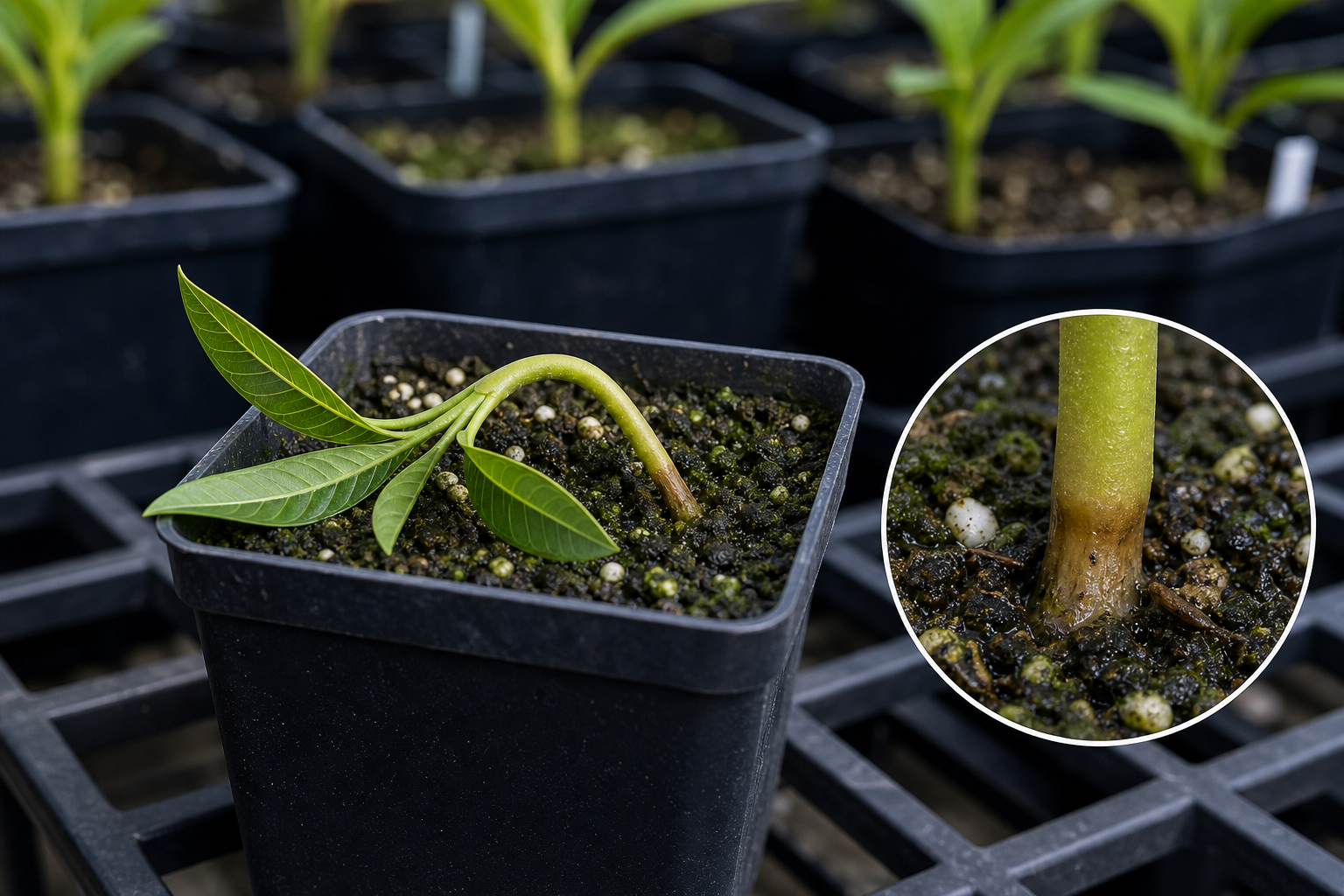 Condition reference
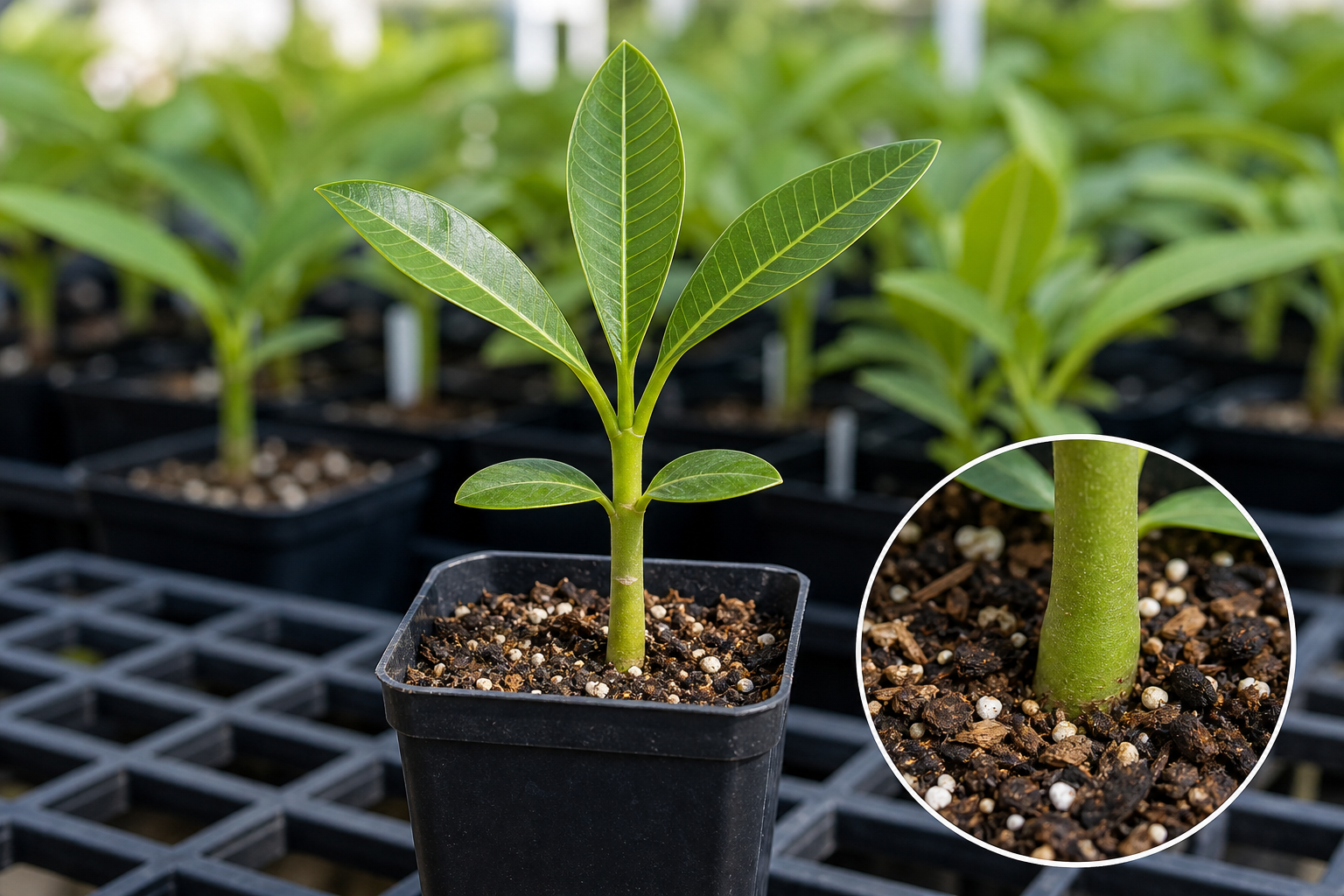 Healthy baseline
- LocationCheck which plant part, age of growth, and exposed or protected side is affected.
- TextureDecide whether the evidence is dry, powdery, sticky, raised, translucent, soft, or intact.
- ProgressionPhotograph the same area so you can tell whether the pattern is stable, improving, or spreading.
Use more than one clue. Confirm the photo with recent conditions, roots, watering history, and the rest of the plant before acting.
Seedling damping-off decision path: Confirm the pattern and progression before changing care.
- Confirm: A seedling stem constricts, darkens, or becomes water-soaked at the soil line and then topples; roots may also decay. Simple leaning from weak light lacks the pinched rotting stem, while dry collapse lacks persistently wet media.
- Start conservatively: Remove and discard collapsed seedlings and nearby contaminated debris, increase gentle airflow, reduce surface wetness, and keep surviving seedlings warm in clean draining medium. Do not try to rescue a fully constricted stem by adding water.
- Escalate only when justified: Use a fungicide, bactericide, wound treatment, or other product only when its label includes the condition and treatment site. Follow all dilution, interval, temperature, protective-equipment, and maximum-application directions.
- Sanitize and contain: When cutting is justified, disinfect tools between cuts with 70% isopropyl alcohol or another labeled tool disinfectant and let the tool dry. Bag suspected infectious material instead of composting it.
- Monitor: Inspect the soil line morning and evening while losses are active, then daily until no new seedlings collapse for one week.
Seedling watering: Keep germination medium evenly moist but never saturated. This differs from an unrooted plumeria cutting, which receives one initial watering and no more until two or three full-sized leaves have developed.
Growing-condition check: Review recent weather, watering, airflow, drainage, plant age and stage, pot or in-ground status, recent applications, and saved microclimate. This is a logical response based on the evidence, not a confirmed laboratory diagnosis.
Use this guide path: Identify | Treat | Prevent | Seedling Overview
Prevent damping-off by giving plumeria seedlings a clean, warm, airy start. Prevention is much more reliable than rescue because collapsed seedlings usually cannot be repaired.
Damping-Off Article Path
Use this group in order when possible: identify the problem, treat only when needed, then prevent repeat outbreaks or recurrence.
- Identify damping-off
How to Identify Damping Off in Plumeria Seedlings – Stem Pinch, Collapse, and Mold - Treat damping-off
How to Treat Damping Off in Plumeria – Tray Rescue, Sanitation, and Airflow - Prevent damping-off
How to Prevent Damping Off in Plumeria – Clean Media, Airflow, and Moisture Control - Use seedling disease guidance
Seedling Damping-Off in Plumeria: Identification, Prevention, and Control
Safety and diagnostics: before applying products, review the Treatment Safety Checklist. If symptoms do not match this group, return to the Seedling Pest and Disease Checklist.
Seedling Disease Diagnostic Path
Use this path when young plumeria are in seed trays, starter pots, humidity domes, or early hardening-off and begin to stall, yellow, mold, rot, or collapse. Seedlings decline faster than mature plants because their stems are tender and their roots are small.
- Start with the seedling pest and disease checklist to separate disease, pests, moisture stress, and weak germination.
- Check damping-off when seedlings pinch at the soil line, fall over, or collapse in trays.
- Check seedling rot when roots, stems, or crowns become soft, wet, or dark.
- Use the seedling fungal disease guide for root, stem, and foliage disease patterns.
- Use the seedborne disease guide when seed quality, storage, contamination, or early germination failure may be involved.
Why: young seedlings have little reserve energy. Fast diagnosis helps you save the healthy seedlings nearby even when a collapsed seedling cannot be rescued.
Quick Answer
Use clean seed-starting media, clean trays, moderate moisture, gentle airflow, bright light, and careful humidity dome timing. Once seeds sprout, begin reducing trapped humidity so the stem base can dry between watering cycles.
Prevention Checklist
| Practice | Best habit | Why |
|---|---|---|
| Clean media | Use fresh seed-starting mix or clean, well-draining starter media. | Young roots need air and low disease pressure. |
| Clean trays | Wash and sanitize trays, domes, labels, and tools before reuse. | Old debris can carry disease into the next batch. |
| Moist, not soggy | Keep media evenly moist during germination, then let the surface breathe. | Constant saturation encourages stem-base disease. |
| Humidity control | Vent or remove domes once seedlings emerge. | Closed humidity after emergence keeps stems too wet. |
| Airflow | Provide gentle movement without drying seedlings harshly. | Air movement reduces mold and strengthens seedlings. |
| Light | Move seedlings into bright suitable light once true growth begins. | Stronger seedlings resist disease better than weak stretched seedlings. |
Adjust Moisture as the Seedling Develops
| Stage | What is normal | Damping-off prevention |
|---|---|---|
| Seed not yet germinated | A correctly shaped plumeria seed may take time to swell and push a root; one ungerminated seed does not prove disease. | Keep the medium warm and evenly moist but airy, never waterlogged. Record the sowing date before assuming failure. |
| Seedling pushing off the protective coat | The emerging seedling normally lifts and sheds the coat as the stem and cotyledons expand. | Do not pull the coat off routinely. Maintain gentle humidity and airflow; intervene only when a dry stuck membrane is clearly constricting growth and can be softened and removed without pulling the seedling. |
| Cotyledons only | The two seed leaves can photosynthesize and support early growth before true leaves appear. | Provide bright appropriate light, begin venting the dome, and keep the soil line from remaining wet. Do not overwater or fertilize heavily to force true leaves. |
| First true leaves | The seedling begins relying on a growing root system and true-leaf photosynthesis. | Remove the dome, space seedlings, water according to actual media moisture, and provide gentle airflow without harsh drying. |
| Crowded young seedlings | Competition and overlapping leaves slow drying and hide stem-base symptoms. | Increase spacing or transplant carefully into clean airy media before roots become tangled and the tray remains continuously wet. |
High-Risk Moments
- Seeds have sprouted but the humidity dome remains closed.
- Seedlings are crowded and the tray surface stays wet.
- Rooms are cool and media dries slowly.
- Old trays or old media are reused without cleaning.
- Weak seedlings stretch under low light.
What Not To Do
- Do not keep seedlings swampy because they are young. Why: tender stems rot easily.
- Do not leave domes sealed after germination. Why: high humidity helps damping-off organisms.
- Do not crowd seedlings too long in tiny cells. Why: airflow drops and roots compete.
- Do not reuse a failed tray without cleaning it. Why: the same disease pressure can carry over.
Bottom Line
Damping-off prevention is about clean starts and controlled moisture. Once seedlings emerge, air, light, and careful watering become more important than keeping the tray sealed and wet.
Confirm Damping Off at the Soil Line
Damping off usually shows itself at or near the media line. That matters because heat stress, dry media, handling injury, and weak roots can also make seedlings wilt or fall over.
- Look for pinched, water-soaked, dark, soft, or collapsed tissue at the stem base.
- Check whether nearby seedlings are beginning to fail in the same area of the tray.
- Inspect the media for excessive moisture, poor airflow, algae, mold, or fungus gnat activity.
- Remove collapsed seedlings and correct moisture and airflow before the problem spreads.
- Do not keep misting or covering a tray that is already too wet.
Seedling Moisture and Tray-Rescue Safeguard
Damping off is a seedling problem. Keep the medium lightly and evenly moist, never saturated, and provide gentle airflow without chilling or dehydrating young seedlings.
- If a seedling is pinched, soft, or collapsed at the soil line: Remove it promptly with the nearby contaminated medium. Do not try to revive a collapsed stem by adding more water.
- For the remaining tray: Improve airflow, reduce excess surface moisture, keep leaves and stems from staying wet, and confirm that containers drain freely.
- For prevention: Begin with clean trays, fresh well-draining medium, clean tools, and careful spacing. Avoid reusing contaminated mix.
Sanitation and moisture correction are the first steps. If a fungicide or biological product is considered, confirm that it is labeled for the crop, site, and suspected organism, and follow the product label exactly.
If symptoms are active now: prevention helps stop problems from returning, but active pests, rot, disease, or root decline may need a different first step. Confirm the problem, then use the Plumeria Treatment Decision Guide to decide whether to monitor, isolate, rinse the canopy, prune, inspect roots, repot, apply a labeled product, or remove badly affected tissue or plants. For timing patterns, compare with the Seasonal Pest Management Calendar.
Related Guides
- How to Identify Damping Off in Plumeria Seedlings – Stem Pinch, Collapse, and Mold
- How to Treat Damping Off in Plumeria – Tray Rescue, Sanitation, and Airflow
- Seedling Damping-Off in Plumeria: Identification, Prevention, and Control
- Seedling Pest and Disease Checklist
- Protecting Plumeria Seedlings from Fungus Gnats
Turn the explanation into an action plan
- Monitor
- Mark lesion borders and photograph the plant every two to three days during rapid change, or weekly when stable.
- Change one thing
- Make the smallest justified correction, record the date, and avoid stacking treatments before you can see which one helped.
- Escalate when needed
- Act quickly when soft decay moves into the trunk, foul odor appears, blackening advances daily, or several plants show the pattern.