
The Plumeria Pests and Diseases Guide is an essential resource for identifying, preventing, and treating the most common threats to plumeria plants, including pests, fungi, and environmental stressors. This guide offers detailed information on how to recognize early signs of trouble, from insect infestations to fungal infections, and provides practical solutions to address these issues. It also covers strategies for managing environmental factors such as excessive humidity, temperature fluctuations, and poor soil conditions, which can weaken plumeria. With expert tips on natural and chemical treatments, as well as proactive care practices, this guide ensures your plumeria remains healthy, resilient, and free from common ailments, allowing it to thrive season after season.
How to Identify Plumeria Seedling Pests: Early Threats to Young Growth
What to check next
This guide helps you confirm that a living pest is present, identify where it is feeding, and choose a measured response without treating inactive damage. Read the detailed explanation, then use this sequence to decide what to do.
Confirm the evidence for a possible insect or pest
- Look for
- Active pests, eggs, cast skins, webbing, honeydew, frass, slime, tunnels, holes, or fresh feeding in the location expected for the pest.
- Compare with
- Disease, water, roots, nutrition, sun, wind, chemicals, and old physical damage can resemble pest injury.
- Safest first response
- Inspect with bright light and magnification, isolate when appropriate, remove manageable pests, and use a labeled control only for a confirmed target.
Microclimate clue: Heat, humidity, rain, dust, protected storage, dense foliage, and nearby host plants can change which pests are likely and how quickly they multiply.
- 1
Inspect before treating
Use bright light and magnification on leaf undersides, tips, petioles, stems, and the soil line.
- 2
Find active evidence
Look for moving pests, eggs, skins, webbing, honeydew, frass, slime trails, holes, or fresh feeding.
- 3
Identify the feeding pattern
Separate sucking, chewing, mining, boring, and root-zone damage.
- 4
Start with the least disruptive action
Isolate, wash, and use only a treatment labeled for the confirmed pest and plant.
- 5
Repeat the inspection
Eggs or protected life stages can survive the first response, so follow-up checks matter.
How microclimate changes this answer
Dry heat favors mites, protected humid growth favors some scale and mealybugs, and wet shade increases snail and slug activity.
This is the focused identification page. If the pest is not yet confirmed, begin with the Seedling Pest and Disease Checklist to separate feeding damage from moisture, disease, light, and normal seedling development.
Identifying seedling pests starts with location: leaves, growing tips, media surface, roots, or night feeding. Many seedling problems are not insects at all, so always compare pest clues with watering, media, light, fertilizer, and disease symptoms.
Plumeria Seedling Pests Article Path
Use this group in order when possible: identify the problem, treat only when needed, then prevent repeat outbreaks or recurrence.
- Identify seedling pests
How to Identify Plumeria Seedling Pests: Early Threats to Young Growth - Treat seedling pests safely
How to Treat Plumeria Seedling Pests: Soil, Foliage, and Tray-Safe Methods - Prevent seedling pests
How to Prevent Pests in Plumeria Seedlings: Tray Hygiene, Airflow, and Moisture Control - Use the seedling checklist
Seedling Pest and Disease Checklist: Protect Young Plumeria Early
Safety and diagnostics: before applying products, review the Treatment Safety Checklist. If symptoms do not match this group, return to the Seedling Pest and Disease Checklist.
Seedling Pest Path
Seedlings, fresh cuttings, and newly rooted plumeria need a lighter hand. Identify the pest, correct moisture and sanitation first, and treat only as strongly as the plant can safely tolerate.
Start With Where the Symptom Appears
Do not spray from a symptom alone. First confirm the pest, its life stage, or a characteristic pattern of damage. Seedling stress, damping-off, excess moisture, heat, and fertilizer injury can look like pest damage.
| Where or pattern | Check first | How to confirm gently |
|---|---|---|
| Media surface or tiny dark flies nearby | Fungus gnats | Use a yellow sticky card to monitor adults. Inspect moist media for slender, translucent larvae with dark heads. Adult flies alone do not prove they caused the seedling damage. |
| Stem narrows, darkens, or collapses at the media line | Damping-off or rot, not usually an insect | Check moisture, drainage, sanitation, and airflow. Remove a collapsed seedling and the small amount of media touching it. |
| Pale stippling, bronzing, or fine webbing under leaves | Spider mites | Tap the leaf over white paper and examine moving specks with a magnifier. Check the leaf undersides first. |
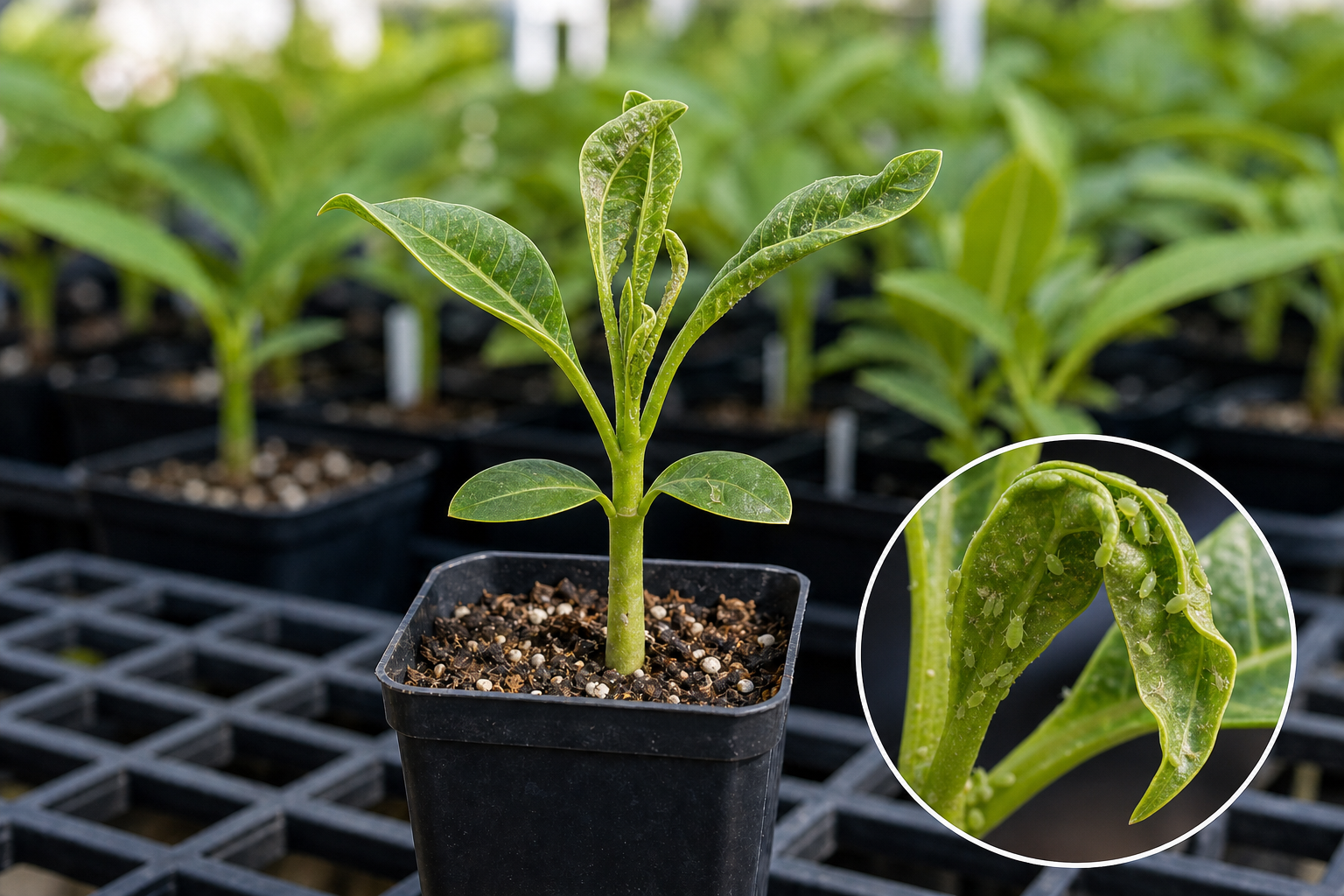
| Curled, sticky new growth with small pear-shaped insects | Aphids | Inspect tender tips and leaf undersides for insects, shed skins, and sticky honeydew. |
| Tiny white insects flutter when the seedling is disturbed | Whiteflies | Look beneath leaves for flat, pale nymphs. Confirm both adults and underside feeding signs. |
| Cottony clusters or firm fixed bumps | Mealybugs or scale | Cottony, mobile insects suggest mealybugs. Firm attached covers or bumps suggest scale. Inspect leaf joints and the stem. |
| Ragged holes, slime, or feeding that appears overnight | Slugs or snails | Inspect after dark or early in the morning, including beneath pots, trays, boards, and nearby debris. |
| Chewed leaves, missing tissue, frass, or a visible larva | Caterpillar | Inspect foliage, stems, and nearby surfaces at dawn or dusk. Confirm a larva or fresh frass before treating. |
| Silvery streaks, distorted young leaves, or dark specks | Thrips | Examine folded new growth and leaf undersides with a magnifier. Tap growth over white paper. |
| Sudden wilt with no visible pest | Root, moisture, heat, or damping-off problem | Check media moisture, stem firmness, root condition, heat exposure, and drainage before assuming insects. |
Quick Identification Guide
| Clue | Likely issue | Why |
|---|---|---|
| Tiny black flies around trays | Fungus gnat adults | Adults show a breeding site; larvae live in moist media. |
| Clear or whitish larvae in wet media | Fungus gnat larvae | Larvae feed on fungi and organic matter and may damage young roots. |
| Fine stippling on leaves | Mites | Mites remove cell contents, often from leaf undersides. |
| Sticky leaves, ants, curled new growth | Aphids, whiteflies, or mealybugs | Honeydew pests often attract ants and distort tender growth. |
| Chewed holes or clipped seedlings | Slugs, snails, caterpillars, or earwigs | Check at night and look for slime trails or droppings. |
| Collapsed stem at media line | Damping-off or rot | This is usually a disease/moisture problem, not a chewing pest. |
How to Confirm
- Tap leaves over white paper to check for moving mite specks.
- Use a hand lens on leaf undersides and tender tips.
- Use yellow sticky cards near the tray to monitor flying adults.
- Place a small potato slice on the media surface to check for fungus gnat larvae, then inspect it regularly.
- Inspect after dark with a flashlight for slugs, snails, earwigs, and caterpillars.
- Slide a root ball out gently if decline suggests root loss, rot, or larvae.
Look-Alikes
- Mite stippling vs. nutrient stress: mite damage is often speckled and starts with underside activity; nutrient issues usually follow a broader pattern.
- Fungus gnats vs. shore flies: fungus gnats are delicate, mosquito-like flies; shore flies are sturdier and often tied to algae.
- Chewing vs. mechanical damage: pest chewing often repeats overnight; handling damage does not keep spreading.
- Pest decline vs. root disease: pests may be present because the media is too wet, while the main damage is rot.
What Not To Do
- Do not treat based only on adults flying around the tray. Why: the damaging fungus gnat stage is the larva in media.
- Do not assume every moving speck is a pest mite. Why: some mites are predatory or harmless; look at damage and location.
- Do not ignore roots. Why: young plants can show leaf symptoms when roots are already struggling.
Young plant caution: seedlings, cuttings, and newly rooted plumeria can be damaged by heavy sprays, strong drenches, excess moisture, and repeated handling. Confirm the problem first, then use the Plumeria Treatment Decision Guide to decide whether to monitor, isolate the tray or pot, rinse gently, improve airflow, adjust moisture, inspect roots, repot, or use a labeled product. For daily checks, use the Seedling Pest and Disease Checklist.
Bottom Line
Seedling pest diagnosis works best when you inspect the whole system: leaf undersides, tips, media surface, roots, trays, moisture, and night activity.
Confirm Seedling Pests Gently
Seedlings are sensitive, so pest control should be based on confirmation rather than guesswork. Heavy sprays, oils, soaps, or drenches can damage tender seedlings if the real issue is moisture, heat, airflow, or media conditions.
- Inspect leaf undersides, tender tips, media surface, tray edges, and the lower stem.
- Use a hand lens when checking for mites, thrips, aphids, or tiny crawling pests.
- For fungus gnats, look for adults, larvae, wet media, algae, and weak roots together.
- For slugs and snails, check at night or early morning for chewing, slime trails, and hiding places.
- Start with environment correction and gentle removal before using stronger treatments.
Photo note: useful photos include the whole seedling tray, the damaged seedling, the pest close-up, and the growing media.
Related Guides
- How to Treat Plumeria Seedling Pests: Soil, Foliage, and Tray-Safe Methods
- How to Prevent Pests in Plumeria Seedlings: Tray Hygiene, Airflow, and Moisture Control
- Seedling Pest and Disease Checklist: Protect Young Plumeria Early
- Organic Pest Control for Plumeria
- Treatment Safety Checklist
Turn the explanation into an action plan
- Monitor
- Check the same marked leaves and nearby plants every three to seven days until no active pests or fresh damage remain.
- Change one thing
- Make the smallest justified correction, record the date, and avoid stacking treatments before you can see which one helped.
- Escalate when needed
- Seek local diagnostic help when damage accelerates despite treatment, borers enter major stems, or the pest cannot be identified.